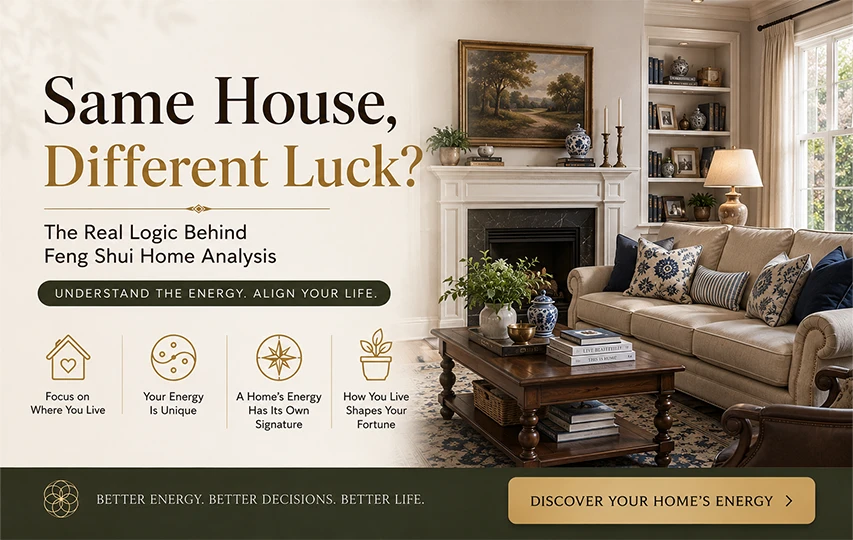

The Real Logic Behind Feng Shui Home Analysis
Many people ask the same two questions when they first explore home Feng Shui:
When analyzing Feng Shui, should you focus on your current home (rental, apartment, dorm, etc.), or a property you own but don’t live in?
Why can two people live in the exact same house, yet one experiences career growth, financial abundance, and smooth relationships—while the other feels stuck, drained, or constantly facing setbacks?
These questions reveal one of the most misunderstood truths in Feng Shui:
A house is fixed. But people are dynamic.
Many people spend years focusing on the wrong property—obsessing over an empty house they own, while ignoring the space they actually live in every day.
As a result, no matter how much they adjust décor or buy Feng Shui cures, their energy and life circumstances barely shift.
Today, let’s break down the real Feng Shui logic behind residential energy analysis in a simple and practical way.
1. Should Feng Shui Be Based on Your Current Home or a Property You Own?
Here is the simplest answer:
Feng Shui is not determined by ownership. It is determined by where your energy is rooted.
Feng Shui is essentially the long-term interaction between your personal energy field and your surrounding environment.
Your fortune is not influenced by a name on a property deed.
It is influenced by the space where you consistently sleep, eat, work, rest, and emotionally recharge.
That environment gradually shapes your mood, clarity, opportunities, relationships, and financial flow.
The 90-Day Energy Rule
A practical Feng Shui principle often used by practitioners is what we can call the 90-Day Rule:
After living in a space consistently for around 90 days, your energy becomes deeply connected with that environment.
Your Primary Residence = Your Main Feng Shui House
Any place where you spend most of your time throughout the year becomes your dominant Feng Shui environment.
This includes:
- Rental apartments
- College dorms
- Employee housing
- Shared apartments
- Temporary relocation homes
- Marriage homes in another city
Even if you only rent month-to-month, as long as you live there consistently, it will influence your current life far more than an empty luxury property.
Empty Properties Usually Have Minimal Influence
A common concern is:
- “My family home has bad Feng Shui. Is it affecting me?”
- “Should I activate or adjust an empty property I own?”
In most cases, the answer is: not significantly.
If no one is actively living there, the energetic exchange is minimal.
A house only becomes energetically active when it is continuously occupied through movement, breathing, sleep, emotion, and daily life.
Without human interaction, its effect on your current fortune is usually very limited.
Exception: Ancestral or Family Homes
Family homes or ancestral houses can carry a different energetic significance.
Even if you no longer live there, they may still symbolically represent:
- family roots
- inherited blessings
- long-term stability
- family karma and support systems
However, they usually do not dominate your day-to-day career luck, relationship flow, or short-term financial opportunities.
For practical Feng Shui adjustments, your current residence should always be your first priority.
2. The Most Fascinating Feng Shui Truth: The Same House Affects Different People Differently
Here’s a phenomenon many people notice:
One person moves into a home and suddenly experiences:
- promotions
- higher income
- clearer thinking
- healthier relationships
Then another person moves into the exact same unit and experiences:
- emotional exhaustion
- money leaks
- career stagnation
- poor sleep and constant stress
Same layout, direction and same building. So what changed? Not the house.
The match between the person and the house.
A home has a relatively fixed energetic structure.
But each person carries a unique energetic blueprint.
Whether those two systems support or clash with each other makes all the difference.
1. Your Personal Elemental Blueprint Is Unique
In classical Feng Shui, each person is believed to carry a unique energetic pattern based on birth data.
This includes:
- elemental tendencies
- directional compatibility
- energetic strengths and weaknesses
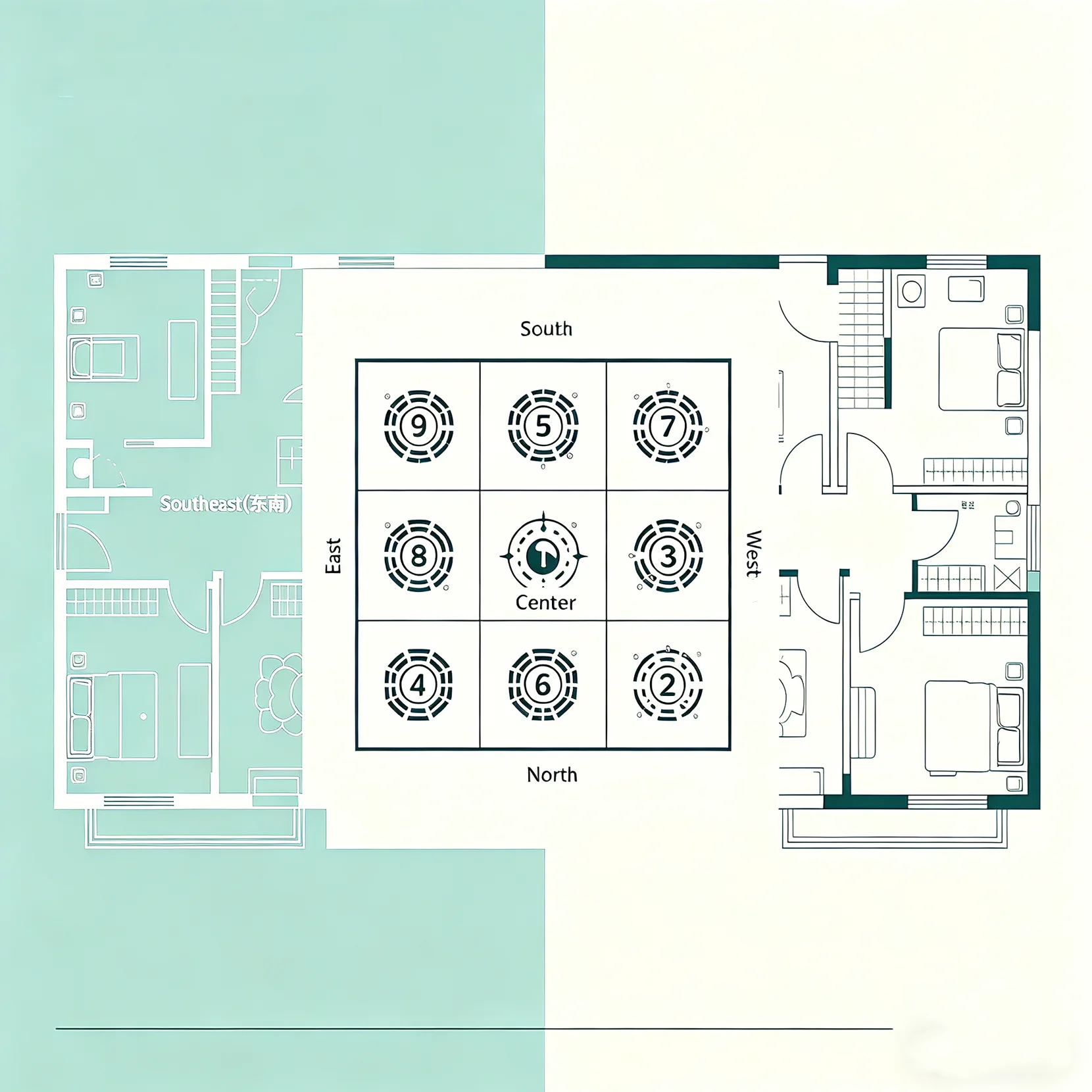
A house also has its own energetic profile, influenced by:
- facing direction
- floor plan
- room positioning
- annual energy cycles
This creates either harmony or friction.
For example:
A person who thrives in strong Fire energy may feel energized, ambitious, and highly productive in a bright, active, south-facing home.
Another person who is already energetically overstimulated by Fire may experience the same space as:
- irritability
- insomnia
- impulsive spending
- emotional tension
So the issue is not whether a house is universally “good” or “bad.”
It is whether the house is aligned with your personal energetic needs.
2. Your Personal Energy Strength Matters
No house is perfectly pure.
Every home contains a mix of:
- supportive energy
- neutral energy
- disruptive or stagnant energy
People with stronger personal energy often tolerate imperfect homes much better.
These are usually people with:
- stable routines
- healthy sleep habits
- emotional regulation
- stronger physical vitality
- clearer mental boundaries
Their personal field is strong enough to absorb positive energy while filtering minor disturbances.
By contrast, people experiencing chronic depletion may be more sensitive to environmental imbalances.
This often includes those dealing with:
- burnout
- anxiety
- poor sleep
- emotional instability
- physical exhaustion
When your own energy is weakened, even a moderately imbalanced space can feel much heavier.
3. How You Use the Space Changes the Outcome
A house is only a framework.
How you live inside it matters just as much as the architecture itself.
The same apartment can produce completely different results depending on daily use.
For example:
In one version of the same home:
- bedroom receives natural sunlight
- bed is positioned with solid wall support
- space is clean and uncluttered
- circulation feels open and calm
This creates a grounded and wealth-supportive environment.
In another version:
- clutter accumulates everywhere
- bed directly faces the door
- poor lighting creates heavy corners
- overhead beams create visual pressure
This often creates subtle stress, scattered focus, and energetic drain.
Even identical floor plans can produce dramatically different experiences depending on organization, lighting, furniture placement, and behavioral patterns.
Final Thoughts: Feng Shui Is About Alignment, Not Superstition
The biggest Feng Shui misconception is believing that luck comes from a house alone.
It doesn’t.
A house only amplifies what is already interacting with it.
True residential Feng Shui is about finding alignment between:
- your personal energy
- your living habits and space layout
- time-based environmental cycles
This is why two people can live in the same home and experience completely different realities.
Because in Feng Shui, it’s never just about the house.
It’s about the relationship between you and the environment you live in.
Your home is not simply where you stay.
It is an energetic ecosystem shaping your everyday reality.
Choose it wisely. Optimize it intentionally.
Discover Your Home’s Hidden Energy Pattern → Get Your House Feng Shui Report
Get to Know Your Five Elements for Free
Get to Know More about Feng Shui